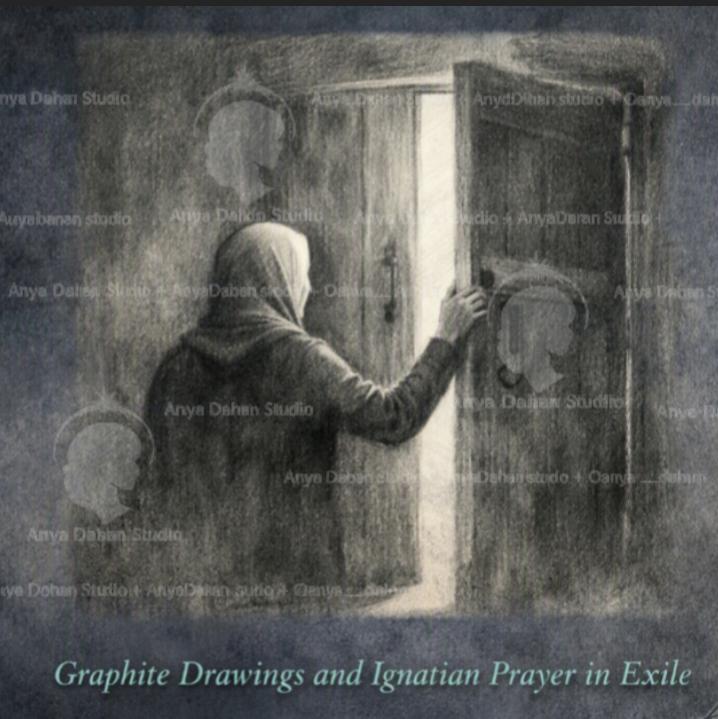
Anya Dahan's "Carved in Time": A Graphite Portrait of an Elder as Political Exile Artwork
There is a distinct kind of silence that accompanies political exile. It is the heavy, suffocating quiet of a life left behind in a hurry—of a home reduced to what can fit into a single backpack. For artist Anya Dahan, fleeing systemic oppression and state persecution meant facing the terrifying reality of erasure.
See: Anya Dahan Carved in Time
But she carried something with her that the state could not dissolve: a single sheet of paper. On it was "Carved in Time," a breathtaking graphite portrait of an elder, drawn during her time in Morocco in March 2020.
This is not just a story about technical mastery. This is the narrative of a drawing that became a shield, a lifeline, and the ultimate refusal to be forgotten.
The Genesis: Contemporary Charcoal and Graphite Realism as Sanctuary
When the world went into lockdown in early 2020, Anya Dahan found herself navigating a double captivity. She was trapped not just by a global pandemic, but by the tightening grip of an oppressive political regime. In the midst of this persecution, she turned to graphite.
"Carved in Time" captures the deeply weathered face of an elder. Every wrinkle is rendered with agonizing, beautiful precision; every line tells a story of survival, history, and quiet dignity. But the process of creating it was far from peaceful. Dahan later described the slow, meticulous rendering of the portrait as a literal act of survival.
When the state attempts to strip away your identity, your legal status, and your safety, time becomes an enemy. By forcing herself to slow down, to focus on the micro-details of another human being's face, Dahan reclaimed her time. Every stroke of the pencil was a quiet rebellion—a declaration that she was still here, still creating, and still human.
The Crossing: A Fragile Drawing's Survival Through Exile
The true weight of Carved in Time shifted when Dahan had to make the perilous journey into exile.
When you flee persecution, you lose almost everything. Photographs, books, clothes, comfort—they are all swallowed by the border. Yet, against all odds, this fragile graphite drawing survived the crossing. It became one of the only physical possessions from Dahan's old life to make it to the other side.
Think about the vulnerability of a graphite drawing. It can smear. It can tear. It can be ruined by a single drop of water or confiscated at a checkpoint. The fact that it survived is a poetic miracle. Carved in Time ceased to be just a piece of art; it transformed into an artifact of displacement. It became physical evidence of a past life, carried across borders like a sacred text.
The Meaning: Visual Art as Activism and Survival
The title itself, Carved in Time, offers a striking irony. Graphite is inherently erasable. It is dust on paper, easily wiped away with the swipe of a thumb. Yet, by naming it Carved, Dahan boldly subverted the medium.
She asserted that the humanity captured in the drawing—and by extension, her own dignity as an artist and a dissident—was permanent. The regime could take her home, her country, and her safety, but they could not erase the reverence she poured into that page.
Carved in Time stands as a powerful reminder to all of us: art is never just decoration. In its truest form, it is a historical record. It is proof of life. For Anya Dahan, the elder in the portrait bears witness not just to their own history, but to the resilience of the artist who held the pencil while the world burned around her.
Comments
No comments yet.
Leave a comment